
Beyond Task Automation: Building Intelligent, Connected Enterprise Workflows
The next stage of enterprise transformation is not simply about automating individual tasks. It is about building intelligent, connected workflows that allow people, applications, and business processes to work together more effectively.
How Smart Automation Is Reshaping the Way Modern Enterprises Operate
As enterprises expand, operational complexity grows alongside them. Multiple departments, disconnected applications, repetitive administrative tasks, and fragmented workflows can make even routine business processes difficult to manage.
Many organizations have already adopted digital tools, yet significant portions of their operations continue to depend on manual coordination, repeated data entry, and disconnected systems.
This is where Smart Automation becomes a strategic business capability.
Executive Summary: Key Shifts in Smart Automation
- Beyond Point Scripts: Move from isolated task scripts to unified, cross-departmental workflow orchestration.
- Integrated Technology Stack: Connect legacy software and cloud SaaS through robust RPA and enterprise APIs.
- Resilience & Governance: Build proactive exception handling, validation checks, and human-in-the-loop oversight.
- Structured Scaling: Follow a verified 5-stage lifecycle from process discovery to continuous optimization.
The Challenge: Digital Systems Without Connected Operations
Organizations frequently invest in enterprise applications, cloud platforms and digital tools. However, when these systems operate independently, the expected operational benefits can remain limited.
Without unified orchestration, teams find themselves acting as manual human glue between software stacks—copying records, chasing approvals, and manually reconciling reports.
Disconnected Business Systems
Information moves between departments through manual processes rather than integrated, automated workflows.
Repetitive Administrative Work
Employees spend valuable high-cognitive hours on redundant data entry, manual document processing, and routine sign-offs.
Delayed Process Handoffs
Cross-functional requests and tasks stall in departmental queues, relying on fragile ad-hoc email chains.
Limited Operational Visibility
Tracking pending activities, SLA commitments, and edge-case exceptions across disparate software becomes nearly impossible.
Legacy Technology Constraints
Core heritage software applications lack modern APIs or native integration capabilities for out-of-the-box automation.
The Core Strategic Realization
“Addressing these challenges requires more than introducing another software application. Enterprises need an automation strategy that connects existing systems and simplifies the way work gets done.”
Smart Automation: Moving Beyond Repetitive Tasks
Smart Automation combines workflow orchestration, Robotic Process Automation (RPA), API integrations, monitoring and intelligent decision support to streamline business operations.
Rather than automating isolated activities, organizations can connect multiple stages of a business process into a coordinated workflow.
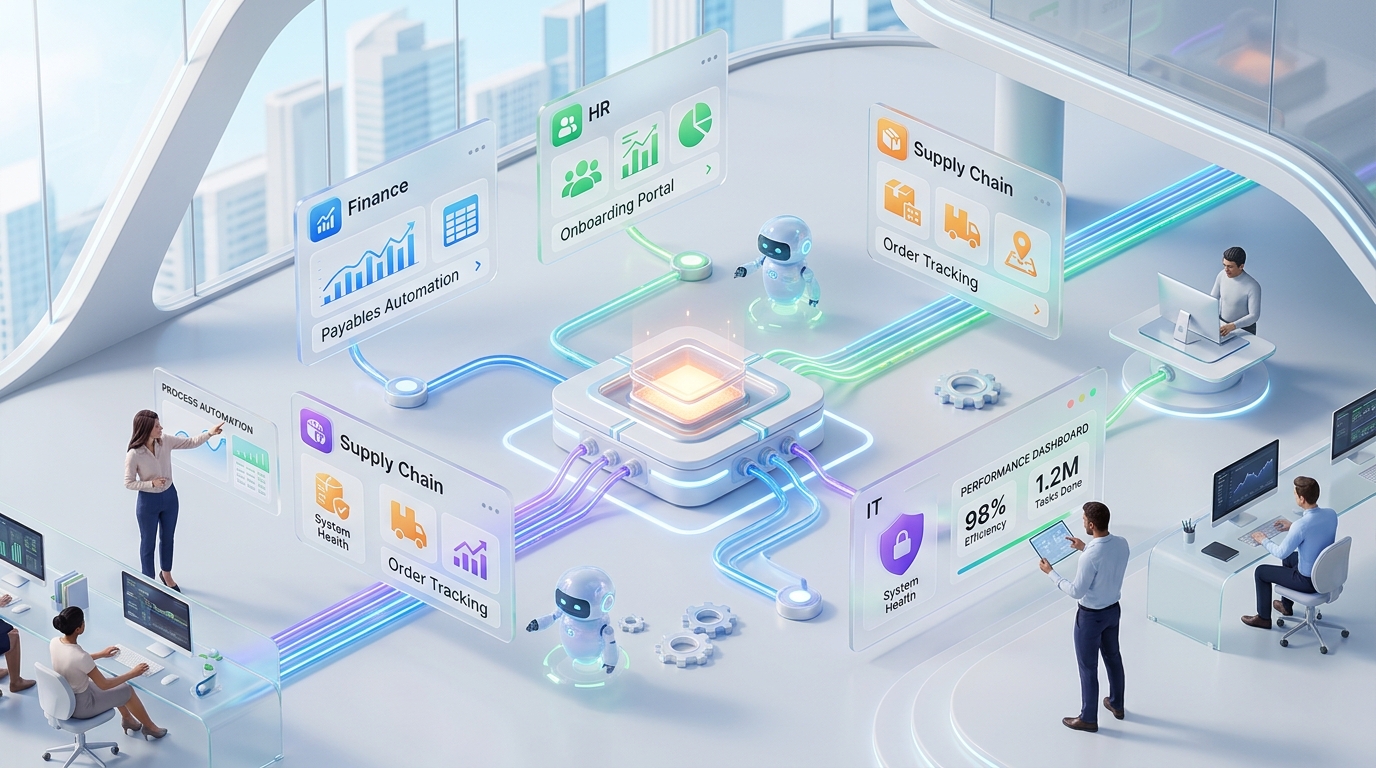
How an Orchestrated Workflow Transforms Financial Operations
Consider an invoice processing workflow that involves document intake, data extraction, validation, approval routing, and exception escalation. When these activities are connected through automation, teams can manage the process with greater consistency and visibility:
Intelligent Document Intake
Invoices received across email, vendor portals, or EDI are automatically ingested and pre-screened.
Automated Data Extraction
Intelligent document processing (IDP) extracts line items, tax IDs, invoice amounts, and terms without manual keying.
3-Way Reconciliation & Validation
Systems automatically cross-verify invoice data against purchase orders (PO) and goods receipt records.
Policy-Based Approval Routing
Clean invoices are routed automatically for single-click executive approval based on dollar thresholds and departments.
Exception Escalation & Human Triage
Discrepancies or price mismatches are instantly flagged and routed directly to the procurement lead with contextual audit notes.
“The objective is not to remove human involvement from every decision. It is to automate repeatable activities while ensuring that exceptions and critical decisions reach the appropriate people.”
How Karanodaka Approaches Smart Automation
Karanodaka helps enterprises design and implement intelligent automation solutions aligned with their operational requirements and existing technology environments.
Its approach focuses on three foundational areas:
Workflow Automation and Orchestration
Business processes often involve multiple departments, approvals and system interactions. Workflow automation connects these activities through structured processes, helping teams manage handoffs, approvals and task execution more efficiently.
RPA and Enterprise Integrations
Robotic Process Automation and API integrations help connect applications, streamline repetitive activities and support data exchange across enterprise systems. This is particularly relevant for organizations working with legacy applications that require integration without extensive system replacement.
Monitoring, Validation and Exception Management
Automation must be reliable, not simply fast. Karanodaka emphasizes validation, monitoring, retries and escalation paths to ensure that exceptions are identified and routed appropriately.
“Automation must be reliable, not simply fast. Validation, monitoring, retries, and escalation paths turn volatile scripts into enterprise-grade operations.”
Where Smart Automation Can Make a Difference
Enterprise automation can support a wide range of operational functions across traditional departmental boundaries:
Finance
Invoice processing, data validation, expense reconciliation, and multi-tier approval workflows.
Human Resources
Automated employee onboarding, equipment provisioning, document verification, and credentialing.
Customer Operations
Customer onboarding, ticket triage & classification, account provisioning, and dynamic service routing.
Supply Chain
Real-time inventory updates, vendor order coordination, dispatch notifications, and operational alerts.
IT Operations
SLA compliance monitoring, automated incident routing, permission resets, and exception handling.
Compliance & Legal
Automated audit documentation, regulatory reporting workflows, verification checks, and governance logs.
Selecting the right opportunity: The most effective automation initiatives depend on process volume, business priorities, system readiness, and the appropriate level of human oversight required.
Building Automation That Scales: A 5-Stage Practical Delivery Approach
Successful enterprise automation requires more than deploying scripts or connecting applications. It requires a structured approach that considers process design, technology compatibility, governance and long-term maintenance.

Process Discovery
Identify repetitive activities, operational bottlenecks and high-impact automation opportunities.
Deep operational analysis to quantify task volumes, cycle delays, and pinpoint high-ROI workflow candidates.
Solution Design
Map workflows, integrations, validation requirements and exception-handling mechanisms.
Architect end-to-end process maps, API endpoints, schema definitions, and human-in-the-loop escalation criteria.
Rapid Prototyping
Develop automation prototypes and validate them through real user feedback.
Build functional workflow slices to test data flow integrity, user experience, and business rule edge cases quickly.
Deployment & Monitoring
Strengthen workflows through monitoring, retries, governance and escalation paths.
Roll out into production with automated retry queues, detailed logging, health checks, and role-based access control.
Continuous Optimization
Evaluate performance against defined business metrics and refine automation as requirements evolve.
Systematic review of cycle times, exception frequencies, and throughput to drive continuous iterative improvements.
This approach helps organizations build automation around actual business processes rather than introducing technology without a clear operational purpose.
Conclusion: From Automation to Intelligent Enterprise Operations
The future of enterprise efficiency will not be defined by the number of tasks an organization automates. It will be defined by how effectively its systems, processes and people work together.
Smart Automation provides a foundation for connecting enterprise applications, simplifying workflows and creating more structured operational environments.
At Karanodaka, we combine workflow automation, RPA, enterprise integrations and intelligent engineering to help organizations modernize the way they operate.
Less Repetitive Work
Better-Connected Systems
More Intelligent Operations
Ready to Modernize Your Enterprise Operations?
Explore Karanodaka's Smart Automation Solutions to discover how intelligent workflows, RPA, and API orchestrations can streamline business processes across your organization.