
Published By
Karanodaka Technologies
Release Date
October 2026
Document Length
8 Pages (Full Edition)
Audience
C-Suite & Enterprise Leads

Copyright © 2026, KaranOdaka (OPC) Private Limited. All Rights Reserved.
Artificial Intelligence is rapidly becoming a strategic priority for businesses across industries. Organizations are investing in intelligent applications, automation, machine learning, and generative AI to improve productivity, accelerate decision-making, and create new opportunities.
But an important question remains: Are organizations realizing the business value they expected from their AI investments?
Implementing AI is only one part of the transformation journey. Many initiatives struggle to progress beyond experimentation because of disconnected workflows, inconsistent data, unclear business objectives, integration challenges, and limited adoption.
The real opportunity is not simply to introduce more AI. It is to identify where intelligence can make a measurable difference and integrate it into the way businesses operate.
The Growing Gap Between AI Adoption and Business Value
Businesses are increasingly exploring AI to improve how they operate. From intelligent document processing and predictive analytics to conversational assistants and automated workflows, the possibilities continue to expand.
However, introducing an AI solution does not automatically improve business performance. Consider an organization that implements an AI-powered system to automate document processing:
The Paradox of Incomplete Automation:
The system may successfully extract information, summarize documents, and reduce manual interaction. But if employees still need to transfer information between disconnected applications, manually verify every result, and maintain parallel processes, the overall business impact remains strictly limited.
The technology works. The transformation remains incomplete.

Figure 1.1: Bridging Disconnected Workflows, Legacy Silos, and Intelligent Data Streams
Figure 1.2: Anatomy of The Enterprise AI Value Gap
What AI Accomplishes
Model accuracy, text synthesis, isolated automated extraction.
THE VALUE GAP
Fragmented data silos, manual handoffs, zero workflow embedding.
Realized Business Value
Shorter cycle times, lowered operating costs, quantifiable net ROI.
Copyright © 2026, KaranOdaka (OPC) Private Limited. All Rights Reserved.
Why AI Initiatives Fail to Deliver Their Full Potential
Several challenges can prevent organizations from translating AI investments into operational improvements. Our research identifies five recurring points of breakdown:
Technology without a clearly defined problem
Some organizations begin with a technology and then search for a business problem to solve. Without clearly defined objectives, AI initiatives can become experiments without a measurable purpose.
Disconnected data and workflows
AI systems depend on relevant information and integration with business processes. When data is fragmented across departments and applications, intelligent systems may lack the context needed to produce useful outcomes.
Automation without transformation
Automating an existing process does not necessarily make that process better. Organizations must examine whether workflows should be redesigned before introducing automation.
Limited human adoption
Even capable AI systems can struggle to deliver value when employees do not understand, trust, or effectively use them. Successful implementation requires appropriate training, transparency, and human involvement.
Measuring technology instead of outcomes
Model accuracy, processing speed, and automation volume are useful technical measures. But business leaders also need to understand whether AI is reducing operational effort, improving service quality, accelerating decisions, or creating measurable financial benefits.
Strategic Principle:
“The question is no longer whether businesses can adopt AI. It is whether they can turn AI capabilities into meaningful outcomes.”
Copyright © 2026, KaranOdaka (OPC) Private Limited. All Rights Reserved.
Five Pillars for Turning AI into Business Impact
Closing the AI Value Gap requires a structured approach that connects technology with business priorities across five foundational pillars:
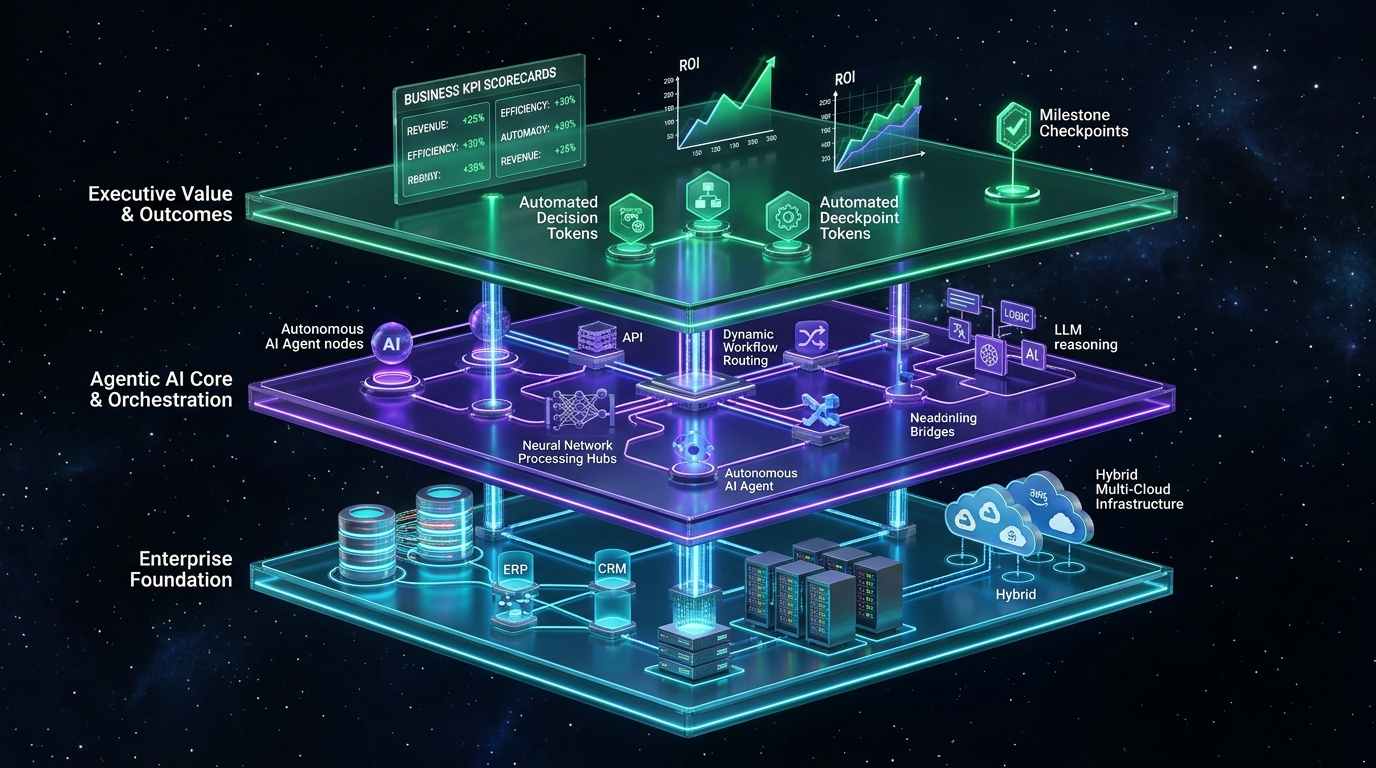
Figure 3.1: The Layered Enterprise AI Architecture — Connecting Data Foundations to Business Outcomes
Start with Business Outcomes
Identify a specific operational challenge before selecting an AI solution. Define what success should look like, establish a baseline, and determine how the outcome will be measured.
Build on Connected Data
Create a reliable foundation by improving data accessibility, quality, consistency, and integration. AI becomes more useful when it can work with relevant business information rather than isolated datasets.
Integrate Intelligence into Workflows
Move beyond standalone AI applications. Connect intelligent capabilities with the systems, teams, and processes where decisions and actions actually happen.
Keep Human Expertise in the Loop
AI should strengthen human capabilities, not eliminate accountability. Establish appropriate approval processes, access controls, validation mechanisms, and escalation procedures.
Measure, Improve, and Scale
Evaluate results against the original business objectives. Learn from implementation, refine the solution, and expand successful use cases where evidence demonstrates value.
Figure 3.2: The 5-Pillar Value Generation Architecture
Copyright © 2026, KaranOdaka (OPC) Private Limited. All Rights Reserved.
From AI Experimentation to Enterprise Transformation
Organizations can approach AI transformation through three progressive stages. Progression should be governed by demonstrated value, not simply by the count of tools deployed.
Experimentation
Explore AI capabilities through focused pilots and proof-of-concept initiatives. The objective is to understand feasibility, identify technical limitations, and validate potential applications.
Operational Integration
Integrate validated solutions into existing applications and daily workflows. Focus on user adoption, data connectivity, reliability, cybersecurity, and measurable operational improvements.
Intelligent Operations
Build connected systems using AI to support analysis, coordinate workflows, and improve decision-making across business functions. Evaluate predictive analytics and appropriately governed AI agents.
Figure 1.3: Enterprise AI Maturity Curve & Governance Gates
Organizations must prove value at each gate before committing incremental capital.
Copyright © 2026, KaranOdaka (OPC) Private Limited. All Rights Reserved.
Measuring What Actually Matters
An effective AI strategy requires more than technical performance indicators. Organizations should evaluate AI initiatives using a combination of operational, financial, and adoption measures:

Figure 5.1: Real-Time Enterprise AI Business Impact & Operational Efficiency Metrics
The Net Business Value Formula
Net Business Value = Measurable Benefits − Total AI Implementation & Operating Costs
Benefits include quantifiable time savings, reduced rework, improved service quality, and incremental revenue. Organizations must distinguish between projected expectations and realized results. A credible AI business case must be supported by empirical evidence.
| Measurement Area | What to Evaluate |
|---|---|
| Productivity | Reduction in repetitive manual effort across operational staff |
| Operational Efficiency | Process turnaround time, error rates, and resource utilization |
| Decision-Making | Speed, consistency, and objective quality of decisions |
| Cost Effectiveness | Total implementation and operating costs against realized benefits |
| User Adoption | Employee engagement, active frequency, and effective utilization |
| Business Impact | Contribution to defined organizational objectives and customer satisfaction |
Copyright © 2026, KaranOdaka (OPC) Private Limited. All Rights Reserved.
The Karanodaka Technologies Perspective
At Karanodaka Technologies, we believe the value of Artificial Intelligence lies in its ability to solve meaningful problems and create practical business outcomes. Our approach focuses on connecting intelligent capabilities with real operational requirements through:

Figure 6.1: Human-in-the-Loop Governance & Multi-Disciplinary AI Decision Framework
What Leaders Should Ask Before Their Next AI Investment
Before committing additional capital to an AI initiative, decision-makers should evaluate five mandatory governance questions:
What specific business problem are we trying to solve?
Do we have the right data and infrastructure to support the solution?
How will AI integrate with our existing processes and applications?
Where should human judgment, approval, and accountability remain?
How will we measure whether the investment has delivered actual value?
Copyright © 2026, KaranOdaka (OPC) Private Limited. All Rights Reserved.
Conclusion: The Future Belongs to Those Who Turn AI into Impact
AI will continue to reshape industries, business models, and operational processes. But the organizations that gain lasting value will not necessarily be those that adopt the most AI tools or make the largest investments.
They will be the ones that understand their business challenges, identify the right opportunities, connect intelligence with action, and measure what genuinely improves.
The next phase of AI transformation is not about doing more with technology alone. It is about achieving more through intelligent application.
Karanodaka Technologies
Engineering Intelligence. Enabling Impact.
Because AI adoption creates possibilities. Business impact creates competitive advantage.
About Karanodaka Technologies
Karanodaka Technologies focuses on developing technology-driven solutions that connect Artificial Intelligence, intelligent applications, and digital innovation with real-world business needs. Our vision is to help organizations move beyond technology adoption and create meaningful value through intelligent solutions.
Consult Our AI Practice
Discuss custom enterprise AI roadmap & ROI validation.
Connect with specialists →Flagship Industrial AI: SafeNod
Explore computer vision safety & EHS compliance.
Visit SafeNod White Papers →Copyright © 2026, KaranOdaka (OPC) Private Limited. All Rights Reserved.